




















Mamata Banerjee vs EC in Supreme Court: "Justice Crying Behind Closed Doors" – WB CM Challenges 'SIR' Voter Revision, SC Issues Notice
The Supreme Court has issued a notice to the Election Commission after West Bengal CM Mamata Banerjee challenged the ongoing 'Special Intensive Revision' (SIR) of electoral rolls. Alleging mass deletion of voters and "harassment," Mamata argued in person, calling the exercise a "precursor to NRC." Get all key highlights from the February 4 hearing.

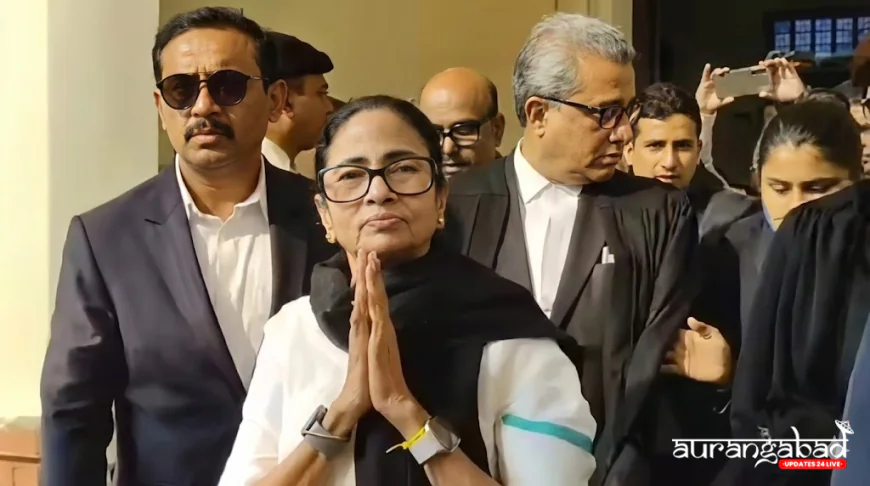
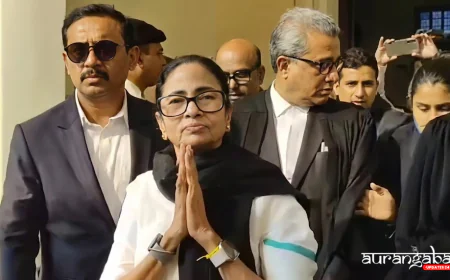
New Delhi: The political standoff between the West Bengal government and the Election Commission of India (ECI) reached the highest court of the land on Wednesday (February 4, 2026). In a rare move, West Bengal Chief Minister Mamata Banerjee appeared in person before the Supreme Court, challenging the ECI's ongoing Special Intensive Revision (SIR) of electoral rolls in the state.
Describing the situation as "justice crying behind closed doors," the Trinamool Congress (TMC) supremo alleged that the SIR exercise was a "calculated move" to disenfranchise millions of genuine voters ahead of the crucial 2026 Assembly Elections. A three-judge bench led by Chief Justice of India (CJI) Surya Kant heard the plea and issued a formal notice to the Election Commission, listing the matter for the next hearing on February 9.
Here is a detailed breakdown of the high-voltage hearing, the controversy surrounding SIR, and the key arguments presented.
What is the 'SIR' Controversy?
The Special Intensive Revision (SIR) is a rigorous electoral roll update exercise launched by the Election Commission. Unlike the standard annual revision, SIR involves a complete door-to-door verification to "purify" voter lists by removing dead, shifted, or ineligible voters.
However, in West Bengal, the exercise has sparked a political firestorm due to its specific criteria:
-
2002 Lineage Mapping: The EC is reportedly verifying voters by linking them to the 2002 electoral rolls or "legacy data." Those unable to establish this "linkage" are categorized as "unmapped."
-
Logical Discrepancies: The EC's software has flagged millions of entries as "logical discrepancies" (e.g., unusual number of voters in one family, age gaps).
-
Micro-Observers: The deployment of over 8,000 "micro-observers" (allegedly from other states) to oversee the process has been termed "unconstitutional" by the TMC.
Mamata Banerjee contends that these strict parameters are a backdoor implementation of the National Register of Citizens (NRC), targeting specific communities and the poor who lack decades-old documentation.
High Drama in Court No. 1: "I Am Not a Bonded Labourer"
The atmosphere in the Supreme Court was charged as the Bengal CM, accompanied by her nephew and MP Abhishek Banerjee, entered the courtroom. Represented by senior advocate Shyam Divan, the petition sought an immediate halt to the deletion of names and the scrapping of the SIR process in favor of a regular revision.
Addressing the bench, Mamata Banerjee made an impassioned plea:
"My Lords, I am here not just as a Chief Minister but as an ordinary citizen. I feel like a bonded labourer. We have written six letters to the Election Commission, but there is no redressal. When justice cries behind closed doors, where do the people go?"
She argued that the EC was treating the state administration with "disdain" and that the deployment of non-statutory "micro-observers" was interfering with the work of state electoral officers.
Key Arguments by the West Bengal Govt
During the hearing, senior counsel Shyam Divan highlighted several alarming statistics to support the claim of mass disenfranchisement:
-
32 Lakh 'Unmapped' Voters: Approximately 32 lakh citizens have not been able to "map" themselves to the 2002 legacy data. The state fears these names will be arbitrarily deleted.
-
1.36 Crore 'Discrepancies': The EC has flagged 1.36 crore entries for "logical discrepancies," putting a massive chunk of the electorate under the scanner just months before the polls.
-
Document Rejection: Valid documents like Aadhaar cards, Domicile certificates, and OBC certificates are allegedly being rejected by ground-level officers under the guise of SIR guidelines.
-
Targeted Exercise: Divan argued, "Why is this rigorous SIR being conducted only in opposition-ruled states like West Bengal, Tamil Nadu, and Kerala, while BJP-ruled states like Assam are exempt?"
Supreme Court's Observation
The bench, comprising CJI Surya Kant and Justices Joymala Bagchi and Vipul Pancholi, listened to the submissions patiently.
-
On Deletions: The CJI remarked, "Every problem has a solution. We must ensure that no innocent or genuine voter is left out of the electoral process."
-
On Migration: The court acknowledged the EC's concern regarding migration and "bloated lists" but emphasized that the process must be transparent and fair. "Revision involves issues of migration, but the right to vote is fundamental," the bench observed.
Refusing to stay the process immediately without hearing the other side, the Court issued a notice to the Election Commission of India and the Chief Electoral Officer (CEO) of West Bengal, seeking their response by February 9.
The Political Fallout: "Garbage of Lies"
The legal battle comes just days after a failed diplomatic attempt. Earlier this week, Mamata Banerjee met Chief Election Commissioner (CEC) Gyanesh Kumar in New Delhi, a meeting that ended abruptly.
-
The Walkout: Reports suggest Mamata stormed out of the meeting, later accusing the CEC of being "arrogant" and feeding her a "garbage of lies."
-
TMC's Stance: The TMC has launched a massive protest campaign, with Mamata even releasing a book of poems titled "SIR: 26 in '26", describing the exercise as a tool of "panic" and "doom."
What Next?
The clock is ticking for the Election Commission, as the SIR exercise is scheduled to conclude within days.
-
February 9 Hearing: The next hearing will be critical. The EC is expected to defend the necessity of SIR for "clean rolls" and counter the allegations of bias.
-
Voter Anxiety: On the ground, confusion reigns supreme. With millions of names in the "doubtful" category, the spectre of the 2019 Assam NRC looms large over Bengal's rural populace.
As the battle shifts from the streets of Kolkata to the corridors of the Supreme Court, the fate of millions of voters hangs in the balance. Will the Supreme Court press the pause button on SIR, or will the EC be allowed to complete its "purification" drive? The nation watches with bated breath.