





















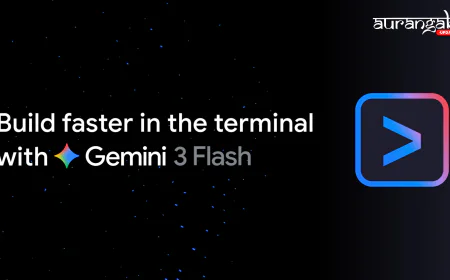













Gemini 3 Flash in CLI: Pro-Level Coding at Flash Speeds (Dec 2025 Update)
Google releases Gemini 3 Flash in the Gemini CLI, delivering 76% SWE-bench scores that match Gemini 3 Pro. Learn how this low-latency, low-cost model revolutionizes agentic coding, massive PR reviews, and automated testing.


Mountain View/Bengaluru: In the world of Large Language Models (LLMs), there has always been a painful trade-off: you could have "Smart" (Pro/Ultra models) or you could have "Fast and Cheap" (Flash models). Developers building autonomous agents often had to bankrupt their API budgets to get decent reasoning or accept mediocre results to save milliseconds.
On December 17, 2025, Google shattered that dichotomy.
With the quiet rollout of Gemini 3 Flash into the Gemini CLI (Command Line Interface), Google has delivered a model that doesn’t just close the gap—it erases it. Boasting a SWE-bench Verified score of 76%, the new Flash model matches the coding prowess of its heavier sibling, Gemini 3 Pro, while maintaining the sub-100ms latency that defines the "Flash" lineage.
For developers, DevOps engineers, and the growing community of "Agentic Engineers," this is the most significant update of the year.
The "Pro" Killer: Breaking Down the Numbers
The headline statistic from Google’s announcement is the SWE-bench score. SWE-bench has become the gold standard for evaluating an AI's ability to solve real-world software engineering problems—not just writing a function, but understanding a repository, reproducing a bug, and creating a patch.
-
Gemini 3 Flash Score: 76%
-
Gemini 3 Pro Score: 76%
-
Gemini 2.5 Pro (Previous Flagship): ~60-65%
This parity is unprecedented. Typically, "Flash" models are distilled versions with significantly reduced reasoning capabilities. However, Gemini 3 Flash appears to have benefited from a new training architecture—likely the same "distilled reasoning" techniques hinted at in the DeepMind papers earlier this year.
By outperforming the previous generation's flagship (Gemini 2.5 Pro) in complex reasoning tasks while costing significantly less, Gemini 3 Flash effectively renders older "Pro" models obsolete for high-frequency tasks.
Why the CLI Release Matters
While API access is great, the Gemini CLI has become the de facto workbench for the modern AI engineer. By making Gemini 3 Flash available directly in the terminal, Google is targeting the "Flow State" of developers.
1. Massive Context for Pull Requests: One of the specific use cases highlighted by Google is the handling of massive Pull Requests (PRs). The blog post notes that Gemini 3 Flash can effortlessly process PRs with over 1,000 comments and thousands of lines of code changes. In the CLI, a developer can now run: gemini review --pr 402 --model gemini-3-flash And receive a nuanced summary, conflict analysis, and code suggestions in seconds, not minutes. The expanded context window (rumored to be 4M+ tokens standard) allows the model to "hold" the entire history of a feature branch in its working memory.
2. Instant Load-Testing Scripts: DevOps teams often struggle with writing boilerplate code for load testing (e.g., k6 or JMeter scripts). Gemini 3 Flash’s low latency makes it ideal for iterative generation. You can pipe your API schema into the CLI and get a robust load-test script instantly: cat swagger.json | gemini "generate k6 load test for 50k users" --flash
The Engine for "Google Antigravity"
This release isn't happening in a vacuum. It coincides with the launch of Google Antigravity, the company's new "Agentic Development Platform."
Antigravity is designed to orchestrate complex, multi-step tasks where agents plan, execute, and verify code. For such a platform to work, the underlying model needs to be fast (to iterate through plans) and accurate (to not break the build).
Gemini 3 Flash seems purpose-built to be the "engine room" for Antigravity. Its ability to handle "Auto-Routing"—intelligently deciding when to call a heavier model or an external tool—makes it the perfect default model for autonomous agents. It can do 90% of the heavy lifting (writing code, fixing syntax, writing docs) at a low cost, only escalating to Gemini 3 Ultra for the most esoteric architectural decisions.
A Broader Ecosystem Update
The December 17 update wasn't just about text and code. The Google Developers Blog also highlighted several other massive leaps in the Gemini ecosystem:
-
Veo 3.1: The video generation model has received a "Fast" variant, now available via API. This allows for near real-time video generation, opening doors for dynamic video personalization in apps.
-
Gemini Robotics-ER 1.5: A new "Embodied Reasoning" model that helps robots understand spatial tasks.
-
Jules' Critic: A fascinating new feature called "Critic-Augmented Generation." It acts as a digital peer reviewer that challenges the AI's own code before showing it to the user, reducing subtle bugs.
The Economic Implication: "Intelligence Too Cheap to Meter"
The release of Gemini 3 Flash signals the commoditization of "Expert Level" coding intelligence. When a model that costs pennies per million tokens can solve 76% of real-world software engineering benchmarks, the barrier to entry for building complex software vanishes.
Startups can now deploy "Junior Developer Agents" that run 24/7, refactoring codebases, writing tests, and updating documentation, all powered by Gemini 3 Flash. The cost of maintaining legacy code—traditionally a massive drain on IT budgets—is set to plummet.
How to Get It
For developers already using the Google Cloud ecosystem, the upgrade path is simple.
-
Update your CLI: Ensure you are on version
0.16.xor higher.npm install -g @google/gemini-cli -
Authenticate:
gemini auth login -
Start Coding:
gemini chat --model gemini-3-flash
Conclusion: With Gemini 3 Flash, Google hasn't just released a faster model; they have fundamentally altered the economics of AI development. By bringing Pro-level capability to the Flash tier, they have given developers the green light to build agents that think deeper, act faster, and cost less. As we head into 2026, the question is no longer "Can AI write this code?" but "Why aren't you using Gemini 3 Flash to write it already?"