


















Elon Musk's 'Desi' Son: Meet Sekhar, the Indian-Origin Heir to the Tesla Empire
Elon Musk has revealed that one of his sons bears the middle name "Sekhar," honoring an Indian Nobel laureate. This article explores the story behind Strider Sekhar Sirius, his mother Shivon Zilis's Indian roots, and Musk's deep respect for Indian science and talent.

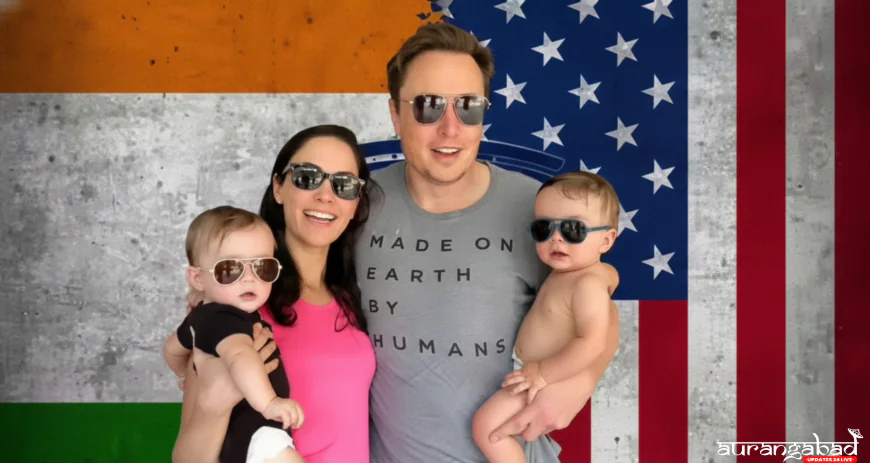
In a revelation that has sent waves of excitement through the Indian internet, tech mogul Elon Musk has disclosed a surprising personal connection to India. While the world knows Musk for his futuristic ventures like Tesla and SpaceX, few were aware that one of his children carries a name deeply rooted in Indian scientific history. Meet Strider Sekhar Sirius, the "desi" heir whose middle name pays homage to one of India's greatest minds.
This revelation came during a candid conversation on the "People by WTF" podcast hosted by Nikhil Kamath, co-founder of Zerodha. Musk’s admission that his partner, Neuralink executive Shivon Zilis, is of Indian descent and that their son is named after a Nobel Prize-winning astrophysicist has added a fascinating cultural layer to the Musk family saga.
Who is 'Sekhar' Musk?
The internet's curiosity was piqued by the phrase "Indian-origin beta," a playful nod to the Hindi word for "son." The child in question is Strider Sekhar Sirius, one of the twins born to Elon Musk and Shivon Zilis in 2021.
While Musk is known for giving his children unconventional names—most notably X Æ A-12 (often called X)—the choice of "Sekhar" stands out for its profound historical and intellectual weight. Unlike the sci-fi-inspired names of his siblings, Sekhar grounds the child in a legacy of terrestrial scientific achievement, bridging the gap between Musk's futuristic ambitions and the foundational physics that make them possible.
The Inspiration: Subrahmanyan Chandrasekhar
Musk revealed that the middle name "Sekhar" is a tribute to Subrahmanyan Chandrasekhar, the legendary Indian-American astrophysicist.
"I’m not sure if you know this, but my partner Shivon is half Indian," Musk told Kamath. "One of my sons with her, his middle name is Sekhar, after Chandrasekhar."
Why is this significant? Subrahmanyan Chandrasekhar was a giant in the field of physics. Born in Lahore in 1910 (then part of British India), he was the nephew of Sir C.V. Raman, another Nobel laureate. Chandrasekhar was awarded the Nobel Prize in Physics in 1983 for his theoretical studies on the physical processes important to the structure and evolution of stars.
His most famous contribution is the Chandrasekhar Limit, which explains the maximum mass of a stable white dwarf star. This discovery was crucial in understanding how stars die and eventually transform into neutron stars or black holes. For a man like Musk, whose eyes are constantly fixed on the cosmos and the mechanics of the universe, naming his son after the man who decoded the destiny of stars is a fitting and deeply respectful tribute.
The Mother: Shivon Zilis and Her Indian Roots
The "desi" connection comes from the child's mother, Shivon Zilis. A top executive at Neuralink, Musk's brain-chip company, Zilis has long been a prominent figure in the artificial intelligence sector. However, her Indian heritage was a detail that remained largely out of the public eye until now.
During the podcast, Musk clarified that Zilis is "half-Indian." While she grew up in Canada, her biological father was of Indian origin. "She was given up for adoption when she was a baby," Musk explained. "I think her father was like an exchange student at the university or something like that. I’m not sure the exact details... but she grew up in Canada."
Zilis’s background is a testament to the global Indian diaspora's success story. She studied economics and philosophy at Yale University, where she also played as a goalie for the ice hockey team. Her career trajectory—from IBM and Bloomberg Beta to OpenAI and Neuralink—places her at the forefront of the technological revolution. For many Indians, knowing that a key figure in the development of future-tech has Indian roots adds a sense of shared pride to her achievements.
Musk on Indian Talent: "America Has Benefited Immensely"
The conversation with Nikhil Kamath wasn't just about family names; it broadened into a discussion about the impact of Indian talent on the global stage. Musk was effusive in his praise for Indian professionals, particularly in the United States.
"I think America has benefited immensely from talented Indians that have come to America," Musk stated.
This sentiment resonates strongly in Silicon Valley, where Indian-origin CEOs lead giants like Google (Sundar Pichai), Microsoft (Satya Nadella), and Adobe (Shantanu Narayen). Musk’s acknowledgment of this contribution highlights the symbiotic relationship between American innovation and Indian intellect. However, he also touched upon the challenges of the current immigration system, noting that tightening visa norms and policy uncertainties are making the "American Dream" harder to access for high-skilled workers.
The "Heir" to the Fortune
While the internet buzzes about "Sekhar," it is important to contextualize his place in the Musk dynasty. Elon Musk is a father to multiple children across different relationships. Strider Sekhar Sirius is part of a large, blended family that includes siblings with names like X, Exa Dark Sideræl (Y), and Techno Mechanicus (Tau).
Being an "heir" to the Musk fortune—currently estimated to be over $250 billion—is not just about wealth. It implies inheriting a legacy of radical innovation, risk-taking, and a vision that spans from electric vehicles on Earth to colonies on Mars. By naming his son after Chandrasekhar, Musk seems to be imbuing the child with a destiny tied to the stars and the rigorous pursuit of knowledge.
Conclusion: A Cultural Constellation
The revelation of Strider Sekhar Sirius’s name is more than just celebrity trivia. It serves as a bridge between cultures and eras. It links the modern, fast-paced world of SpaceX and Neuralink with the timeless, disciplined brilliance of 20th-century astrophysics.
For India, it is a moment of "cultural glow"—a validation of its scientific heritage by one of the most influential men of the 21st century. It reminds us that while borders may define countries, science and knowledge have no boundaries. Little Sekhar Musk may just be a toddler today, but he carries a name that has already written its place in the stars.